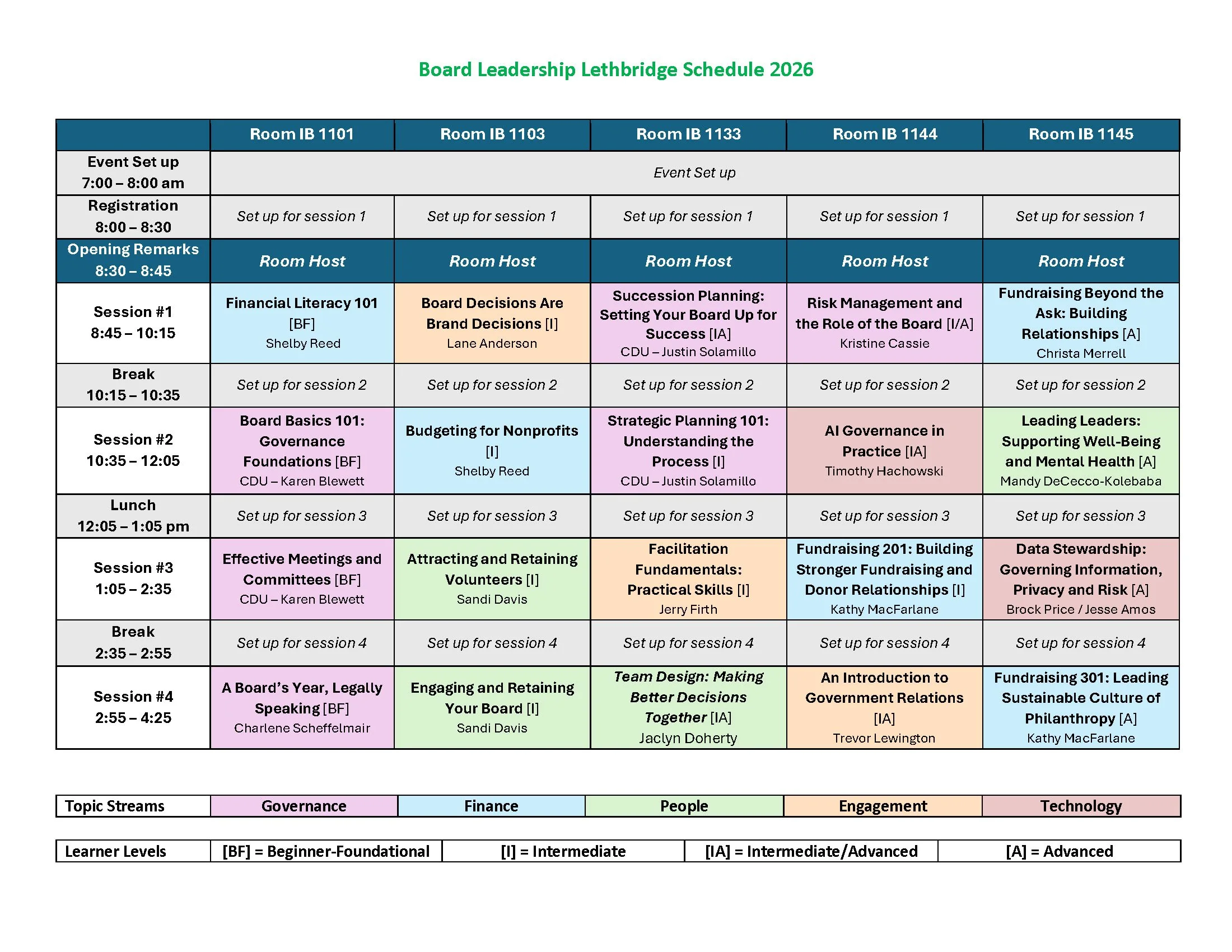
Saturday at Board Leadership Lethbridge is designed to put you in the driver’s seat. With five sessions running concurrently in each time slot, you’ll choose four sessions throughout the day that best fit your needs, interests, organization and experience.
To help you navigate your options, each session has been assigned a learner level: Beginner/Foundational [BF], Intermediate [I], Intermediate/Advanced [IA] or Advanced [A]. These levels are simply a guide to help you find sessions that match your knowledge and experience. They are not prerequisites, so feel free to choose any session that catches your interest.
We’ve also organized sessions into five topic streams: Governance, Finance, People, Engagement and Technology. Whether you want to build your boardroom basics, dive deeper into a specific issue, explore a new area or simply follow your curiosity, there’s no wrong way to build your Saturday. Scroll to the bottom of this page to view a colour-coded schedule that clearly shows the topic streams and learner levels.
Saturday Session Descriptions
-
Financial Literacy 101 [BF]
Presented by Shelby Reed
Each board member has a fiduciary duty to understand the financial status of the organization, and to administer, monitor, and distribute the assets of the organizations they serve. They must work to ensure long-term financial stability, monitor the use of funds, and ensure that controls are in place to protect the organization against error or fraud.
-
Board Basics 101: Governance Foundations [BF]
Presented by Karen Blewett
So, what does an effective board look like? This session explores board roles and responsibilities, governance and oversight, and the skills and qualities that contribute to an effective board. Participants will also have the opportunity to share experiences, learn from others, and access additional resources to support their board work.
-
Effective Meetings & Committees: From Agenda to Action [BF]
Presented by Karen Blewett
Effective meetings are essential to productive board work. This session explores what makes a board meeting effective, including focused agendas, effective decision-making, time management, and clear roles and expectations. We’ll also explore the role of committees, including how to clarify their purpose, responsibilities, and connection to the board’s priorities. Leave with practical tips and resources to help make your board meetings more focused and purposeful.
-
A Board's Year, Legally Speaking [BF]
Presented by Charlene Scheffelmair
Board service comes with legal obligations that rarely arrive with a clear explanation. Structured around the recurring rhythm of a board year, including onboarding, annual general meetings, regular board meetings, and financials, this session gives participants a working grasp of their legal duties as directors, what compliance actually requires of them, how to navigate a conflict of interest, and where governance ends and operations begin. Led by a commercial lawyer who has sat in nearly every seat at the board table, from treasurer to chair, this session offers a grounded, practical foundation for those new to board service, along with guidance on where to turn when questions arise.
-
Board Decisions Are Brand Decisions [I]
Presented by Lane Anderson
Board members contribute to shaping their organization's brand all the time whether they realize it or not when they approve a program, handle a crisis, or sign off on the annual report. This session looks at those everyday decisions and shows how brand is a consideration in each one, whether your role on the board is more hands-on or more big-picture. We'll work through real board scenarios in small groups, then leave with a simple checklist for weighing brand alongside the financial and legal questions boards already ask, plus a few resources for learning more after the session.
-
Budgeting for Non-profits [I]
Presented by Shelby Reed
A key component of financial sustainability is the commitment of board and staff to financial management that includes timely review of financial reports and advance planning. One way that the board and staff plan for income and expenses in the future is by creating a budget. Learn how to develop, manage, and use budgets to support decision-making in this session.
-
Attracting and Retaining Volunteers [I]
Presented by Sandi Davis
Volunteering is changing, and organizations need to adapt how they attract, engage, and retain volunteers. This intermediate-level session explores practical strategies for recruitment, onboarding, training, support, recognition, and creating meaningful volunteer experiences. Participants will consider what motivates people to volunteer, what keeps them engaged, and why they may choose to leave. They will leave with practical ideas to strengthen their programs and events, create a more welcoming and rewarding volunteer experience, and build stronger, longer-term volunteer engagement.
-
Board Members Are Volunteers Too: Engaging & Retaining Your Board [I]
Presented by Sandi Davis
Board members are volunteers too, and their experience matters. This intermediate-level session explores practical strategies for recruiting, onboarding, engaging, and retaining effective board members. Participants will consider what motivates people to serve, how clear roles and expectations support engagement, and how to create meaningful governance experiences. The session will also explore board recruitment, succession planning, and building a strong leadership pipeline, providing practical ideas to strengthen engagement, improve the board volunteer experience, and build a more effective and sustainable board.
-
Strategic Planning 101: Understanding the Process [I]
Presented by Justin Solomillo
This session explores the principles and processes that underpin effective strategic planning in nonprofit organizations. Participants will examine the role of vision and mission, environmental scanning, strategic priorities and goals, and implementation within the overall planning process. The session will also consider the board’s role in strategic planning and how a strategic plan supports organizational direction and decision-making. Participants will leave with a stronger understanding of the purpose, key components, and stages of strategic planning, and how they work together to provide focus and direction for a nonprofit organization.
-
Facilitation Fundamentals: Practical Skills for Leading Effective Conversations [I]
Presented by Jerry Firth
This interactive, hands-on workshop introduces core facilitation skills that help groups move from discussion to clarity and action. Participants will explore the role of the facilitator, key competencies, and tools for idea generation, structured discussion, and decision-making. Through guided discussion and small-group exercises, participants will practice facilitation techniques and learn how to design conversations with clear outcomes and strong guiding questions that can be applied in meetings, planning sessions, and collaborative discussions.
-
Fundraising 201: Building Stronger Fundraising and Donor Relationships [I]
Presented by Crystal Elliott
Designed for boards and nonprofit leaders with some fundraising experience, this session explores practical strategies to build on existing fundraising efforts and shift mindsets and habits to fund development and sustainability. Participants will learn how annual giving, events, and sponsorship connect to effective donor-stewardship in creating readiness for a transition towards major gifts and other longer-term donor relationship-building. Through real-world examples and practical tools, attendees will leave with ideas they can adapt to strengthen fund development within their own organizations.
-
Succession Planning: Setting Your Board Up for Success [IA]
Presented by Justin Solamillo
Planning for succession is critical to ensuring board continuity and the success of your organization. Learn how board evaluations, understanding skill gaps, nurturing people and having frameworks in place can give potential recruits the confidence that this a board they want to join. Discussion about the benefits of building a strong board will complement practical tools that boards can use.
-
A Team Design Challenge: Making Better Decisions Together [IA]
Presented by Jaclyn Doherty
Boards regularly make decisions with incomplete information, competing perspectives, and no obvious answer. In this highly interactive session, participants will take on a creative challenge that requires them to interpret information, consider different perspectives, make choices, and adapt as new information emerges. Through clues, questions, decisions, and something to create, participants will explore how groups build shared understanding and exercise collective judgement. The session concludes by connecting the experience back to board decision-making, including how decisions are reached and communicated in ways that build understanding and confidence. Expect conversation, unexpected discoveries, imperfect prototypes, and a few surprises.
-
Risk Management and the Role of the Board: Governing for Organizational Resilience [IA]
Presented by Kristine Cassie
Every nonprofit operates in an environment of financial, operational, reputational, and strategic uncertainty. This session explores how boards can govern proactively for resilience by identifying, assessing, prioritizing, and monitoring organizational risk. Participants will examine risk registers, risk appetite, mitigation strategies, and the distinction between board oversight and management’s operational responsibilities. The session will also address crisis and reputational risk, leadership accountability, and director duty of care. Participants will leave with practical tools and questions to strengthen risk oversight, support informed board decision-making, and build organizational resilience that protects mission, operations, and public trust.
-
AI Governance in Practice: Risk, Policy, and the Board's Role [IA]
Presented by Timothy Hachkowski
Most nonprofits are already using AI often without a policy, a record, or a decision anyone can point to. This session focuses on the governance of these new technologies: where AI genuinely helps, where the real risk sits in your organization's data, and how a board judges whether its organization is ready. We'll cover what belongs in a one-page AI policy, the transparency and ethics questions that come with AI-assisted decisions, and what boards should be asking their executive director. Through a hands-on risk-sorting exercise and a look at genuinely hard cases, participants leave with a practical checklist for their next board meeting.
-
An Introduction to Government Relations [IA]
Presented by Trevor Lewington
This course will provide an overview of the basic components of developing a government relations strategy, why it matters and provide participants with the opportunity to engage in several practical exercises.
-
Fundraising 301: Leading a Sustainable Culture of Philanthropy [A]
Presented by Crystal Elliott
Designed for experienced boards and organizational leaders seeking their next challenge in strengthen big-picture fundraising capacity. Participants will explore the leadership habits that support sustainable philanthropy, including major gift strategy, campaign readiness, governance, success measures and fostering a strong culture of philanthropy. Time permitting the session will touch on legacy giving as a key component of a robust, integrated plan. Drawing on practical experience and strategic insights, the session will help attendees identify priorities, prospects and practises to build lasting relational fund development success.
-
Fundraising Beyond the Ask: Building Relationships That Inspire Giving [A]
Presented by Christa Merrell
The best fundraising doesn’t start with asking — it starts with a conversation that makes people want to be part of something bigger. This advanced, interactive session explores a relationship-centred approach to nonprofit fundraising in an evolving funding landscape. Participants will explore how boards can build trust, deepen relationships, identify shared values, and create meaningful connections with donors, businesses, foundations, government, and community partners. Through practical examples and discussion, the session will examine how strong relationships can support funding diversification, from individual and major giving to corporate partnerships, grants, and community fundraising. Participants will be encouraged to shift their thinking from simply “finding funding” to building a sustainable network of people and partners who believe in the mission and can contribute to long-term organizational sustainability.
-
Leading Leaders: Boards Supporting Executive Well-Being and Mental Health [A]
Presented by Mandy DeCecco-Kolebaba
Led by a certified therapist, this session helps boards strengthen executive resilience and well-being. Participants will learn how governance choices, communication, and culture shape leadership effectiveness, and gain practical strategies — including developing policies to prevent burnout and support mental health — to foster a supportive, sustainable environment.